
When consumers need to find a nearby clinic, restaurant, repair shop, store or service provider, one of their first actions is usually a Google search.
At that moment, companies with a well-optimized Google Business Profile have a better chance of appearing with their address, phone number, opening hours, reviews, photos, products and directions.
The profile can be created and managed for free by eligible businesses that serve customers at a physical address or within a defined service area.
Quick answer
Google Business Profile matters because it puts a company in front of consumers who are already looking for products or services nearby. In addition to expanding visibility in Search and Maps, it facilitates calls, website visits, direction requests and purchase decisions.
Why is Google Business Profile important?
It connects an immediate consumer need with a company that can meet it. International data from BrightLocal helps illustrate this behavior:
The figures come from an international BrightLocal study published in 2026 and may not represent behavior in every individual market.
1. It increases visibility in local searches
A profile can appear when someone searches for “dentist near me,” “restaurant open now,” “computer repair in Chicago” or other locally focused terms. Results appear in both Google Search and Google Maps, often before the consumer visits a website.
According to Google, local ranking is mainly based on three factors:
Relevance
How closely the profile information matches the user's search. The correct category, a clear description, registered services and complete details help Google understand the business.
Distance
The proximity between the consumer and the business. When an exact location is unavailable, other signals are used to estimate the area.
Prominence
How well known the business is. Reviews, online mentions, links, articles and other signals can help identify established and relevant companies.
A company cannot control the consumer's location, but it can continually improve its relevance and local prominence.
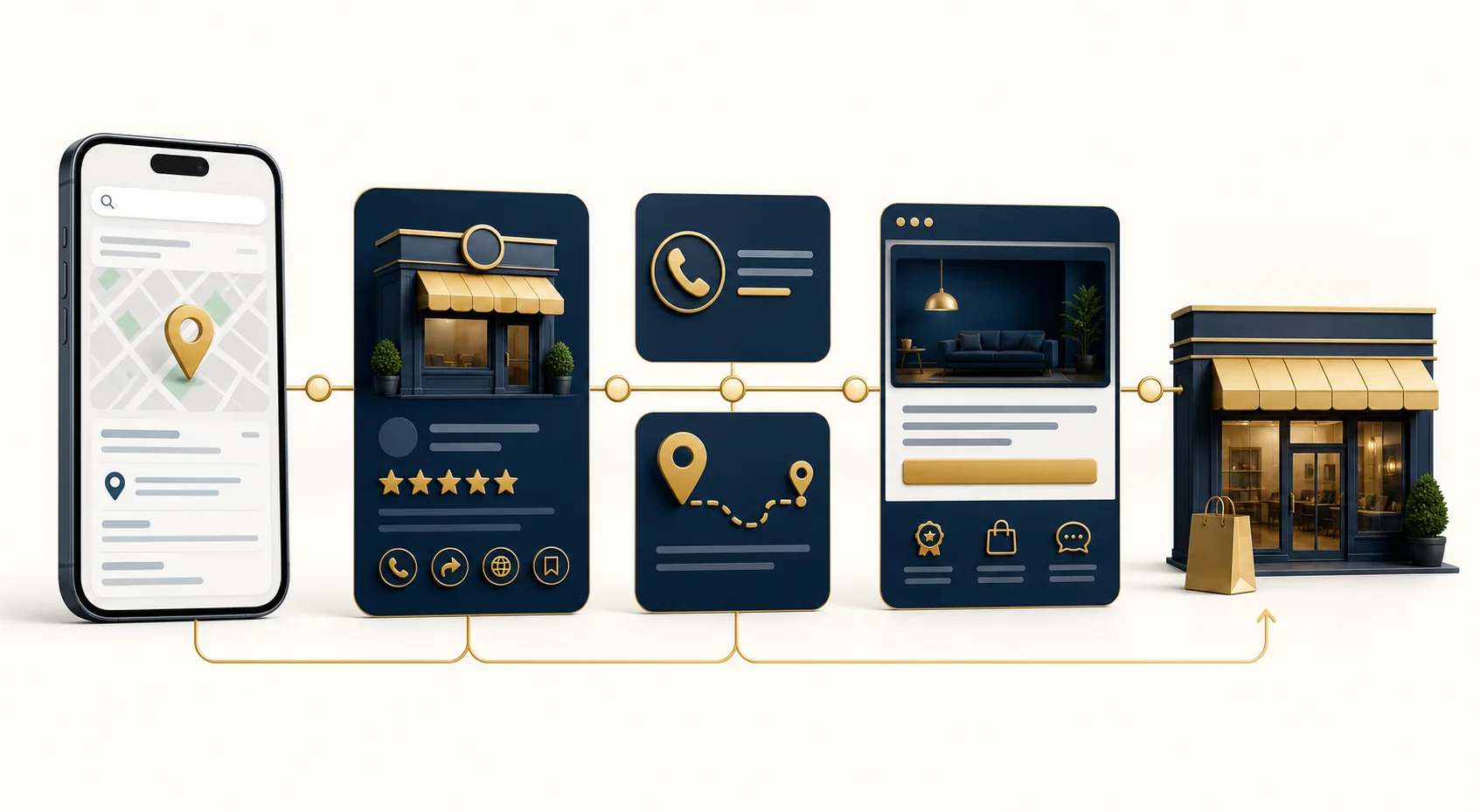
2. It reaches consumers with purchase intent
A local search usually begins with a specific need. Someone searching for “pizza open now” probably intends to order; someone looking for a “plumber nearby” may need immediate service.
Contact may happen through a call, website visit, directions request, reservation, appointment or product view. Available features vary by category, region and configuration.
3. It strengthens business credibility
BrightLocal's international Local Consumer Review Survey 2026 reports that 97% of consumers use reviews to guide decisions, while 71% used Google to read them.
Reviews act as social proof and help consumers assess service, deadlines, product quality and problem-solving ability. Reputation, however, is not determined by star count alone.
How to respond to reviews correctly
- Thank the customer for the comment;
- Show that you understood their experience;
- Avoid generic or defensive responses;
- Offer a solution when there is a problem;
- Protect personal information;
- Maintain a professional tone.
Never offer discounts, gifts or payments in exchange for positive reviews. Google requires reviews to reflect genuine experiences and prohibits incentives.
4. It simplifies the customer journey
A complete profile lets people quickly discover whether a business is open, where it is located, which number to call, what it offers, how to get there and what other customers say. Incorrect information creates frustration and may send the customer to a competitor.
5. It helps manage digital reputation
After claiming and verifying the profile, the owner gains greater control over how business information is presented. They can correct details, add photos, respond to reviews, update opening hours, list products and monitor performance.
6. It provides data for marketing decisions
Depending on the available features, a company can track search terms, views, website clicks, calls and direction requests. Google's Business Profile performance documentation explains how these interactions are recorded.
The goal is not simply to accumulate views, but to identify which actions can become genuine business opportunities.
7. It creates an advantage for small businesses
Creating and managing a profile has no direct financial cost. Small businesses can compete for local attention with larger companies when they provide complete information, better photos, recent reviews and efficient service.
Having a profile alone does not guarantee top positions. The difference comes from managing it actively, consistently and according to the guidelines.
How to optimize a Google Business Profile
Complete all relevant information
- Real-world business name;
- Appropriate primary category;
- Necessary secondary categories;
- Address or service area;
- Phone number and website;
- Regular and special hours;
- Business description;
- Products, services and attributes.
Choose the primary category carefully
Use the most specific option that describes your core activity. Avoid broad categories when a precise alternative exists.
Publish high-quality, authentic photos
Include the storefront, interior, team, products, completed services, entrance and visual identity. Real photos help customers recognize the business and understand the experience.
Keep opening hours current
Update the profile for holidays, closures, schedule changes, exceptional hours or temporary shutdowns.
Add products and services
Use clear names and objective descriptions. Avoid artificial keyword repetition.
Request reviews from real customers
Create a post-service routine using messaging, email, QR codes or follow-up messages, without making the request conditional on a positive review.
Publish relevant updates
Share events, news, new products, schedule changes and important announcements while following platform policies.
Common Google Business Profile mistakes
- Leaving phone numbers and opening hours outdated;
- Using an inappropriate category;
- Creating duplicate profiles;
- Adding keywords to the official business name;
- Using an address where customers are not served;
- Publishing generic or misleading photos;
- Ignoring negative reviews;
- Buying reviews;
- Listing cities without eligible operations;
- Abandoning the profile after verification.
The name should match how the business is recognized in the real world. Google's business representation guidelines also recommend one profile per eligible business or location.
How to measure the return from your profile
| Goal | Primary metric |
|---|---|
| Generate store visits | Direction requests |
| Receive new contacts | Calls and website clicks |
| Strengthen reputation | Review quantity, frequency and quality |
| Promote services | Profile views and interactions |
| Generate appointments | Recorded bookings or conversions |
| Improve local presence | Visibility for category-related terms |
Use UTM parameters on the website link to identify visits from the profile. A simple structure is ?utm_source=google&utm_medium=organic&utm_campaign=business_profile. Review results monthly and compare similar periods.
Does Google Business Profile replace a website?
No. The profile facilitates quick local discovery, while a website provides room to present services, differentiators, case studies, content and conversion pages.
A consistent strategy combines a complete profile, a fast mobile website, service- and location-specific pages, authentic reviews, consistent business information and useful content.
Frequently asked questions
Can a business without a storefront create a profile?
Yes, provided it meets customers in person. Service providers may define a service area and hide their address if customers are not received there.
Do you have to pay to appear on Google Maps?
No. Creating and managing a Business Profile is free. Ads can expand reach but are not required for an organic profile.
How often should the profile be updated?
There is no universal frequency. Correct essential data immediately and review photos, services, reviews and posts regularly.
Can I add a city or service to the business name?
Only when it is part of the real, recognized name. Artificially adding keywords may violate the guidelines.
Does one negative review permanently harm the profile?
Not necessarily. A professional response and a genuine effort to solve the issue can demonstrate responsibility. Reviews that violate policies can be reported.
Is Google Business Profile useful for B2B companies?
Yes, especially when they meet customers in person or operate in specific regions, such as offices, local consultancies, suppliers and maintenance companies.
Does creating several profiles help a company rank in more cities?
No. Each profile must represent a real, eligible operation. Duplicate profiles or artificial locations may lead to restrictions.
Conclusion
The importance of Google Business Profile lies in connecting companies with consumers at the moment they search for a solution. A complete profile can increase visibility on Maps, make contact easier, strengthen reputation and provide valuable data.
The best results depend on accurate information, authentic reviews, strong images, professional responses and continuous management. For companies that depend on local customers, ignoring the profile leaves room for better-prepared competitors.
Want to strengthen your company's local presence?
Fergro combines Google Business Profile, local SEO, content and measurement to turn searches into opportunities.
Book a consultation